
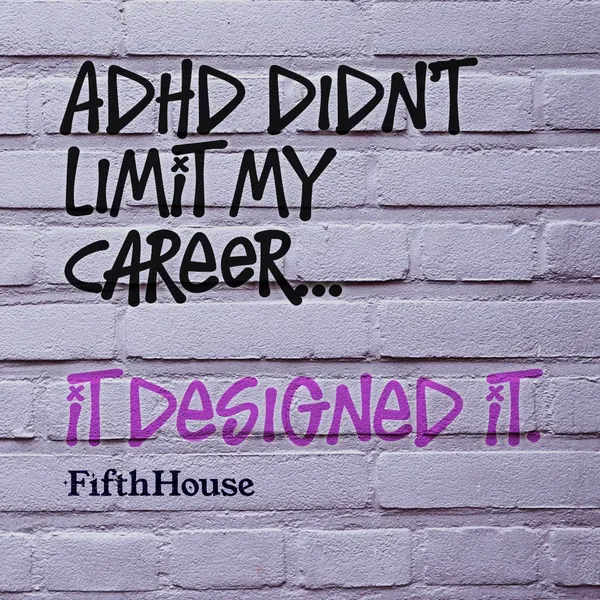
Why ADHD Built the Career I Was Meant For
I spent years trying to work around how my brain operates. Then I built a studio around it instead.
I didn’t grow up knowing design was a career.
I grew up in a working-class military family where the message was simple: go to college. Nobody specified what for. So I got there and had no idea what I wanted to study.
That changed when I reconnected with a friend from high school who was majoring in graphic design. I’d never heard of it. She described it as art and computers, which was, at the time, a fairly accurate summary of how I was already spending my nights: in Photoshop, rebuilding my MySpace layout with CSS tricks I’d found on somebody’s forum post.
I declared the major that semester. It turned out to be the only decision in that entire period I got right on the first try.
The Part I Spent Years Hiding
Looking back, I’m not sure why I bothered. When I finally told people I had ADHD, nobody was surprised. Not one person. Which was, honestly, a little insulting.
For years before that I thought I needed to hide it. Mask it. Work around it like a defect in the equipment. Build elaborate systems so nobody would notice the thing everybody had already noticed.
What I eventually understood is that the problem was never how I was wired. It was that I kept putting that wiring into roles it didn’t fit.
I do well in variety. I move fast. I connect things that aren’t obviously connected. I see a problem forming before it’s a problem. In the right seat, that’s most of what creative direction is.
In the wrong seat, it reads as somebody who won’t stay in her lane.
Most Roles Wanted Me in the Lane
Execute. Design. Don’t lead.
That was the shape of nearly every job I had. Take the brief, make the thing, hand it back. Strategy happened in a different room, usually without a designer in it, and by the time the work reached me the important decisions were already made badly.
Design school didn’t train me to make things look good. It trained me to think. I wanted the work to function, not just render. I wanted to be in the room where the brief got written, talk to the client directly, and say something when the plan wouldn’t hold.
Ten years into that, I had enough experience to build my own room.
What I Built Instead
A studio where strategy and execution live in the same place. Where the person who sets the direction is also the person accountable for what ships.
The irony is that building it required more structure than any job I ever had, not less. Recurring invoices. Templated processes. Documented steps. A review before anything goes out. Everything I can automate, I automate, and not because I’m lazy. Every decision I remove is one less thing competing for attention I don’t have to spare.
That structure is why the studio works. It’s also why clients never have to think about any of this. The systems hold the process so the process doesn’t depend on me remembering it.
What This Is and Isn’t
I’m not arguing that ADHD is a creative superpower. I’ve written about why that framing does more harm than good. The hard parts are genuinely hard and no amount of reframing makes an unfinished task finish itself.
What I’m arguing is narrower and more useful: fit matters more than fixing. I spent a decade trying to become someone who worked well inside roles built for a different kind of thinking. That was effort spent in the wrong direction.
The traits that made me a difficult fit for staying in the lane are the same ones that make me good at running a studio. Nothing about me changed. The seat did.
The Takeaway
If you’re early in this and trying to file down the parts of yourself that don’t fit where you are, I’d think carefully about whether the problem is you or the fit.
Sometimes it really is you, and the honest move is to get better at something. But sometimes you’re doing excellent work in a role that has no use for it, and the amount of energy you’re spending to seem like a different person is the reason you’re exhausted.
I didn’t leave traditional roles because I couldn’t keep up. I left because I was ready to lead and there was nowhere to do it. FifthHouse exists because of how I’m wired, not in spite of it.
If you’re looking for a creative partner who handles the strategy and the execution, here’s how that works.